
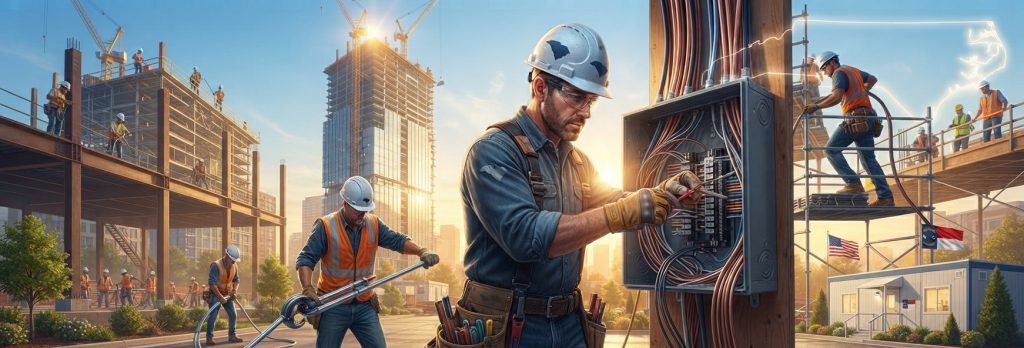
North and South Carolina are experiencing significant growth in commercial construction, manufacturing, infrastructure, healthcare, logistics, and other industries. As businesses expand and new facilities are built across the Carolinas, one trade is becoming increasingly essential to keeping projects on schedule: commercial construction electricians.
From new office buildings and distribution centers to manufacturing plants, hospitals, retail developments, and large industrial facilities, virtually every modern commercial project depends on a skilled electrical workforce. The challenge is that demand for experienced electricians is growing at a time when the construction industry is already facing a shortage of skilled workers.
Construction Growth Is Driving Electrical Demand
North Carolina’s construction industry has continued to add jobs in 2026. State employment data showed construction employment increasing by 2,900 jobs in June alone. Earlier in the year, construction had also been one of the state’s leading sources of employment growth.
That growth creates demand throughout the construction supply chain, including electrical contractors and the electricians needed to install, maintain, and commission increasingly sophisticated electrical systems.
South Carolina is experiencing similar development pressure, particularly in rapidly expanding markets such as Greenville, Charleston, Columbia, and the Upstate. New manufacturing facilities, warehouses, commercial developments, infrastructure projects, and population growth are creating additional demand for construction professionals.
For commercial electricians, this translates into opportunities across a wide range of projects.
Modern Commercial Buildings Require More Electrical Work
Today’s commercial buildings are considerably more complex than many buildings constructed in previous decades. Electrical contractors may be responsible for everything from basic power distribution to sophisticated building systems.
Commercial construction electricians commonly work on:
- Electrical service and distribution systems
- Lighting and lighting controls
- Switchgear and panel installation
- Generators and backup power systems
- Fire alarm systems
- Security and access-control systems
- Data and communications infrastructure
- EV charging infrastructure
- Energy-management systems
- Industrial machinery connections
- Building automation systems
- High-voltage and specialized electrical installations
As buildings become more technology-dependent, electrical work is becoming an increasingly important component of the overall construction process.
Manufacturing and Industrial Expansion
One of the biggest drivers of electrical demand in the Carolinas is industrial development.
Manufacturing facilities require substantial electrical infrastructure to operate production equipment, automated systems, conveyors, robotics, climate-control equipment, lighting, safety systems, and communications networks.
This means industrial construction projects often require electricians with experience beyond traditional commercial installations. Contractors need workers who can read detailed plans, understand electrical codes, troubleshoot complex systems, and coordinate their work with other trades.
The growth of advanced manufacturing also creates a need for electricians who are comfortable working around automation, controls, instrumentation, and increasingly sophisticated electrical equipment.
Data Centers and Infrastructure Add Another Layer of Demand
The national expansion of data centers, grid infrastructure, and energy-intensive facilities is placing additional pressure on the skilled electrical workforce. A 2026 Reuters report noted that the United States is facing significant shortages of skilled workers in power and construction, with particularly strong demand in regions including the Carolinas.
These projects can require large electrical crews and specialized expertise in power distribution, backup generation, transformers, switchgear, controls, and other systems.
Even projects that are not data centers can be affected by this competition for skilled labor. When major infrastructure projects recruit experienced electricians, commercial contractors may have a harder time finding qualified workers for other construction projects.
The Skilled-Labor Shortage Is a Major Challenge
The need for commercial electricians isn’t simply the result of more buildings being constructed. It is also the result of an industry workforce that is struggling to keep pace with demand.
As experienced electricians retire, contractors must replace years of knowledge and field experience while simultaneously training new workers.
This creates several challenges for commercial construction companies:
Project scheduling: A shortage of qualified electricians can make it harder to staff projects on schedule.
Labor costs: Competition for experienced workers can increase compensation and recruitment costs.
Project complexity: Modern electrical systems require increasingly specialized knowledge.
Safety and quality: Electrical work must be performed correctly and according to applicable codes and project specifications.
Training: Contractors must continually develop apprentices and entry-level workers to build the next generation of skilled electricians.
For general contractors and electrical contractors alike, having access to dependable electrical talent can make a significant difference in a project’s success.
Why Commercial Electricians Are Essential to Project Timelines
Electrical work is closely connected to nearly every phase of commercial construction.
Electricians may begin by installing underground utilities and temporary power before moving into rough-in work, service installation, equipment connections, lighting, controls, testing, and final commissioning.
Delays in electrical work can affect other trades and ultimately push back inspections, equipment startup, and building occupancy.
That is why experienced commercial construction electricians are more than simply another trade on the jobsite. They are an important part of keeping the entire construction schedule moving.
Opportunities for Electricians in the Carolinas
For electricians, North and South Carolina offer an expanding market with opportunities across multiple sectors.
Experienced professionals may find work on:
- Commercial buildings
- Manufacturing facilities
- Warehouses and distribution centers
- Hospitals and healthcare facilities
- Schools and universities
- Hotels and hospitality projects
- Retail developments
- Data centers
- Industrial facilities
- Infrastructure and energy projects
Electricians who continue developing their skills in areas such as automation, controls, renewable energy, EV infrastructure, and advanced power systems can position themselves for additional opportunities as commercial construction evolves.
Building the Electrical Workforce of Tomorrow
Meeting the Carolinas’ demand for commercial electricians will require more than hiring experienced workers. The industry also needs to invest in apprenticeships, vocational education, on-the-job training, and long-term career development.
Apprenticeships are particularly important because electrical work combines classroom knowledge with hands-on experience. Developing new electricians takes time, which makes workforce planning essential for contractors expecting continued growth.
Companies that invest in their workforce today will be better positioned to compete for commercial projects tomorrow.
The Outlook for Commercial Construction Electricians
The demand for commercial construction electricians in North and South Carolina is being driven by several forces at once: continued construction activity, industrial investment, population growth, infrastructure needs, technological advancement, and a shortage of skilled labor.
North Carolina’s construction employment gains in 2026 demonstrate that the demand for construction workers remains strong. Meanwhile, broader workforce shortages are making skilled electrical professionals increasingly valuable throughout the Carolinas.
For contractors, the message is clear: having access to qualified commercial electricians is critical to completing projects safely, efficiently, and on schedule.
For electricians and people considering a career in the skilled trades, the message is equally important. The Carolinas’ continued commercial and industrial development is creating a strong need for people with the skills to power the buildings, facilities, and infrastructure of the future.
As North and South Carolina continue to grow, commercial electricians will remain an essential part of that growth.

